

Dulse
Looking for a natural source of nutrients from the sea? Dulse, also known as Palmaria palmata, is a red seaweed from the Atlantic Ocean with a rich history and an impressive nutritional profile. This seaweed has been used as a nutritious ingredient for centuries and is becoming increasingly popular in modern diets too.
Written by Lisanne - last updated 06-06-2025
Contents
- Our favourite Atlantic dulse
- What is dulse (Palmaria palmata)?
- Where does dulse grow and how is it harvested?
- What nutrients does dulse contain?
- How can you use dulse in your daily diet?
- Sources
Our favourite Atlantic dulse
What is dulse (Palmaria palmata)?
Dulse is an edible red seaweed belonging to the Palmariaceae family. Its botanical name, Palmaria palmata, refers to the seaweed's hand-shaped fronds. Dulse has a deep reddish-purple colour and a nutty flavour, and is traditionally harvested along the rocky shores of the North Atlantic Ocean.
The seaweed grows naturally along the coastlines of Ireland, Iceland and Canada, where it has been part of the daily diet for centuries. Its flavour and texture also make Atlantic dulse popular as a savoury umami substitute in vegetarian and vegan cooking.
Where does dulse grow and how is it harvested?
Dulse grows in cool, mineral-rich waters, where it attaches itself to rocks in intertidal zones. Harvesting usually takes place between June and September, when the fronds are at their thickest and most nutritious. Atlantic dulse is harvested by hand along the Irish coast and then dried at a low temperature to preserve its raw quality.
This sustainable harvesting method minimises the impact on the ecosystem and maximises nutrient retention. The seaweed is only picked when fully grown, helping the plant regenerate and supporting the biodiversity of the marine habitat.
What nutrients does dulse contain?
Dulse is known as a nutrient-dense seaweed. Several studies show that Palmaria palmata is rich in:
- Protein (up to 35% of its dry weight)
- Essential amino acids, including lysine and methionine
- Vitamins such as A, B1, B2, B12 and C
- Minerals such as potassium, calcium, magnesium, iron and manganese
- Iodine, a trace element that occurs naturally in many seaweeds
- Important compounds such as polyphenols and carotenoids
These findings are described in a review of the nutritional value of dulse (source) and in recent research into bioactive compounds in red seaweeds (source), among other studies.
With this impressive nutritional profile, dulse offers a natural way to enrich a varied diet.
How can you use dulse in your daily diet?
Dulse flakes and dulse powder are versatile ingredients. With its soft texture and savoury flavour, dulse works well in:
- Soups and broths
- Vegetable dishes and sauces
- Smoothies or protein shakes (including plant-based shakes)
- Dressings or as a topping for salads
- Savoury recipes as a substitute for salt or stock
Many people also use dulse as an ingredient in seaweed blends or detox recipes. For example, it is listed as an ingredient in the popular Heavy Metal Detox Smoothie by Anthony William (Medical Medium).
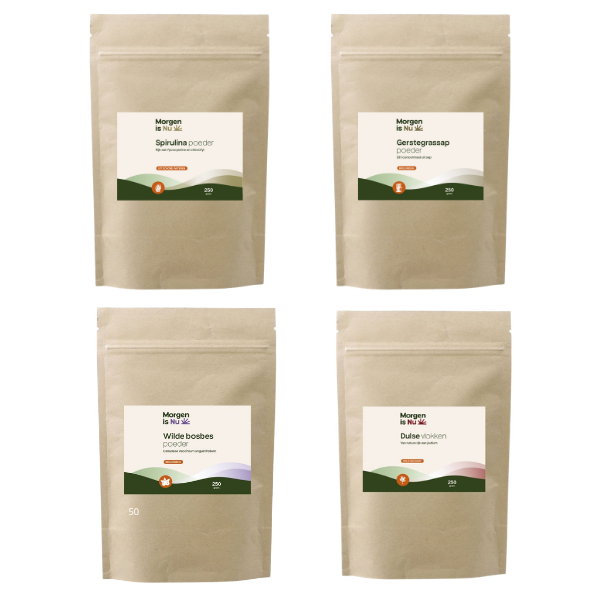
Our organic Dulse Vlokken are raw, unrefined and made from 100% Palmaria palmata. They are harvested by hand during the peak season and dried at a low temperature for optimal quality. Nothing else.
Sources


Bundle | United States of America, Finland, Ireland


"Delivery is always quick. I've ordered these products several times before and they are of high quality."
- Catharina Claessens
Date of experience: 9 May 2025
View all reviews
About Morgen is Nu - Holistic health shop
At Morgen is Nu, we work every day to support your health. Guided by a unique vision and years of experience, we select only the purest, highest-quality products. We believe in a holistic approach centred on physical, inner and outer balance.
Telephone: 0341 - 422 850
Our mission is that people with the correct information choose their health products
Dulse is a red seaweed that stands out for:
- Its nutty, umami-rich flavour
- Its soft, leaf-like texture
- A relatively high protein content compared with other varieties
- Its intense reddish-purple colour (compared with the green of nori, for example, or the brown of kelp)
While nori is often used as a sushi wrap and kelp is popular in broths, dulse is valued as a versatile addition in powder or flake form. Each seaweed has its own nutrient profile, flavour and uses, and dulse is particularly appreciated for its mild flavour and texture.