

Cat’s Claw
Looking to buy Cat’s Claw? This vigorous climbing plant from the Amazon has a long history of traditional use and has grown in popularity in recent years. There is good reason for this: more and more people are discovering what indigenous cultures have known for centuries. On this page, you can read about where Cat’s Claw comes from, how it is processed and what the research says.
By Stefan, last updated: 08/10/2025.
Contents
- Our favourite Cat’s Claw supplements
- What is Cat’s Claw?
- Different species of cat’s claw
- The origins and traditional use of Cat’s Claw
- Cat’s Claw and the immune system: what does the research say?
- Effects on the innate and adaptive immune systems
- How is Cat’s Claw harvested and processed?
- Sources
Our favourite Cat’s Claw supplements
- Cat's Claw (Kattenklauw) 10:1 by Morgen is Nu
- Cat’s Claw Bark (Kattenklauw) by Nature’s Answer
- Cat’s Claw 10:1 by Vimergy
What is Cat’s Claw?
Cat’s Claw is a woody, tropical climbing plant (botanical name Uncaria tomentosa) that grows in the rainforests of South and Central America. The plant can reach tens of metres in height and is recognisable by its small, curved thorns. These resemble a cat’s claw, hence the name Cat’s Claw. Its botanical name also refers to this: Uncaria is derived from the Latin “uncinatus”, meaning “hooked”.
Different species of cat’s claw
Please note: not all cat’s claw is the same. The botanical species Uncaria tomentosa is the most widely used because it contains specific plant compounds, such as oxindole alkaloids. (source)
The other species, Uncaria guianensis, is sometimes sold under the name cat’s claw, but it does not contain the same proportions of active compounds.
The origins and traditional use of Cat’s Claw
Indigenous peoples in Peru, Colombia and Brazil have used Cat’s Claw as part of their herbal medicine for more than 2000 years. The inner bark in particular is used for its bioactive compounds. (source)
This centuries-old use has also attracted the attention of modern science. In particular, Cat’s Claw is being studied for its potential to support the immune system*. This interest is consistent with the plant’s traditional use.
Cat’s Claw and the immune system: what does the research say?
Cat's Claw contributes to the normal function of the immune system*. It is therefore no surprise that many scientific studies focus on the composition of this plant and its effects on our immune system. Particular attention is paid to certain plant compounds, such as pentacyclic oxindole alkaloids. Laboratory research has examined how these compounds may influence certain processes in the body. (source)
Effects on the innate and adaptive immune systems
The bioactive compounds in Cat’s Claw influence both the innate and adaptive immune systems*. The innate immune system forms the body’s first line of defence and responds quickly to invaders. White blood cells play a key role here: they detect foreign substances, destroy bacteria and viruses, and clear away damaged cells through a process called phagocytosis.
The adaptive immune system, on the other hand, focuses on recognising and eliminating specific pathogens. T and B lymphocytes are essential to this process, as they develop into specialised immune cells or produce antibodies.
The plant’s effects on the immune system are attributed to compounds belonging to the pentacyclic oxindole alkaloid group. (source, source)
How is Cat’s Claw harvested and processed?
Traditionally, the inner bark of the stem or root of Cat’s Claw is harvested for use. As worldwide demand has increased, sustainable harvesting methods have been developed. Today, the stem of plants that are at least eight years old is preferred. This leaves the root intact and allows the plant to recover. (source)
In sustainable cultivation, the climbing plant is cut back to about one metre above the ground, after which it grows back fully within a few years. Only the inner bark is used, after the outer bark has been carefully removed.
Sources
- Uncaria tomentosa (willd.) D.C.: Cat’s Claw, Una de Gato, or Saventaro.
- Pharmacology and therapeutic uses of cat’s claw
- The effects of Uncaria tomentosa on the immune system
- Uncaria tomentosa (willd) Dc. Ethnomedical use and new pharmacological, toxicological and botanical results
- Assessment report on Uncaria tomentosa (Willd. ex Schult.) DC., cortex
* Health claim pending European authorisation.
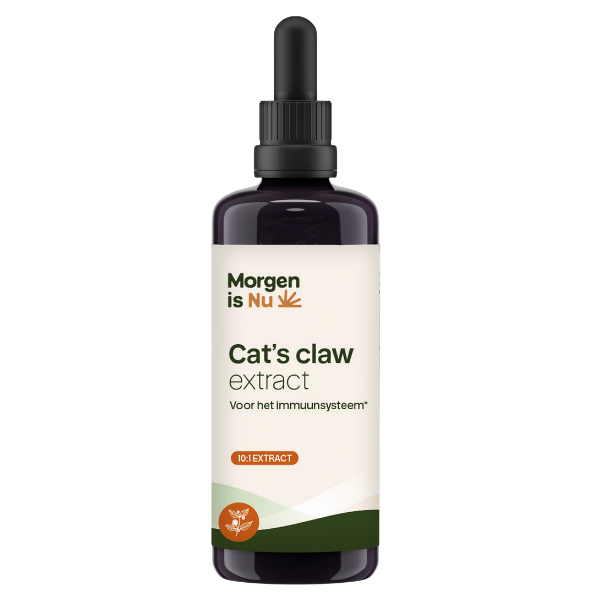
100ml | Liquid | Cat's Claw | Germany


60ml | Liquid | Cat's Claw | United States of America
"Quick delivery. I hadn't heard of the product (cat's claw) before, but I'm trying it now. I'm hopeful, now just waiting for (lasting) results."
- Caroline
Date of experience: 22 April 2025
View all reviews
About Morgen is Nu: Holistic Health Shop
At Morgen is Nu, we work every day to support your health. Guided by a unique vision and years of experience, we select only the purest, highest-quality products. We believe in a holistic approach that centres on balance, physically, internally and externally.
Telephone: 0341 - 422 850
Blog about Cat’s Claw
From the treetops of the Amazon rainforest to today's herbal cupboard, Cat’s Claw (Uncaria tomentosa) has a rich history and a promising future. This climbing plant with hooked thorns has been used for centuries by indigenous peoples for its revitalising properties. Scientists are also taking a growing interest in the unique plant compounds found in its bark and roots, particularly for their possible influence on the immune system*.
In this blog, you'll discover exactly what Cat’s Claw is, why not all ‘cat's claw’ is the same, and how this vine can support our natural defences in different ways. Curious about why we at Morgen is Nu are so enthusiastic about this remarkable plant? Read on to find out.

Cat’s Claw is generally well tolerated when used as directed. As with any herbal supplement, it is important to be aware of individual sensitivities. In some cases, mild stomach discomfort or dizziness has been reported.
Historically, Cat's Claw was used as a contraceptive and to induce abortion. Do not use Cat's Claw during pregnancy. Also, do not use Cat's Claw for more than 2 weeks alongside immunosuppressive medication, such as prednisone and ciclosporin.
The botanical name of the most widely studied species is Uncaria tomentosa. When choosing products containing extracts of this plant, it is important to check the botanical name. Closely related plants are also commonly called cat’s claw, but contain fewer or none of the main active compounds. The correct plant contains more than 60 different active compounds. The main group of active compounds is known as pentacyclic oxindole alkaloids (also abbreviated to POAs). Research shows that compounds in this group are important for the normal functioning of our immune system*. So always choose a supplement that clearly states the botanical origin.
Cat’s Claw is best known for its positive effect on our immune system*. It is a plant traditionally used in South America. Other uses mentioned in traditional practice or preliminary studies are not legally authorised health claims.
There is no evidence that normal use of Cat’s Claw is harmful to healthy kidneys. However, if you have existing kidney problems or take medication, you are always advised to seek medical advice first. Long-term use or high doses have not been studied in people with kidney problems and are therefore not recommended without supervision.
The dosage can vary depending on the product and its intended use. Studies often mention amounts between 250 and 1000 mg per day, depending on the form of extract and the concentration of active compounds. Always follow the dosage on the product label, or consult a qualified professional for personalised advice.
There is no convincing scientific evidence that Cat’s Claw has a direct effect on hormone levels. Some sources speculate about a possible indirect effect, but this has not been confirmed in large-scale clinical research. For this reason, no health claims may be made about this.
Most health claims are currently linked to vitamins, minerals and fatty acids. For herbs and botanicals, discussions have been ongoing for years. Various on-hold claims have been submitted for this. These are currently awaiting approval by the European Commission. The claims may therefore currently only be used if there is scientific substantiation for the health effect.