

Wild Blueberry Powder
Looking to buy wild blueberry powder? Discover the power of this natural product, packed with wild blueberries carefully picked in the forests of Finland and Canada. Ideal for adding to your smoothie, yoghurt or juice. Read on to learn about its origins, composition and the differences between the species.
By Stefan, last updated: 22-07-2025.
Contents
- Our favourite wild blueberry powders
- What is wild blueberry powder?
- The difference between Vaccinium myrtillus and Vaccinium angustifolium
- The unique composition of wild blueberry powder
- Sources
Our favourite wild blueberry powders
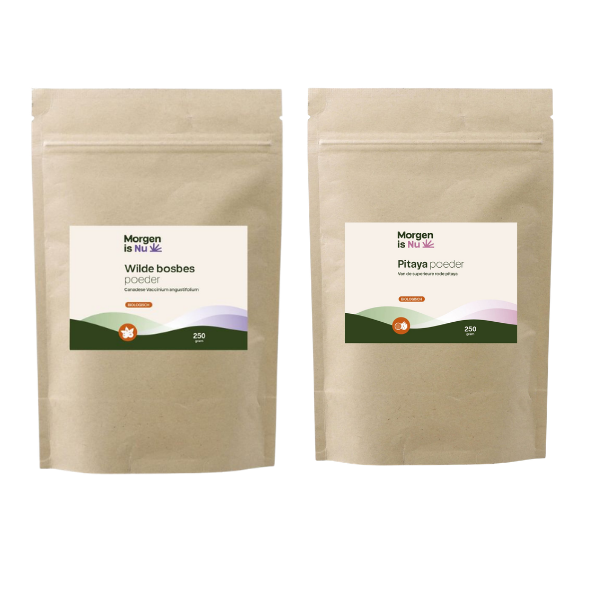
- Bio Wilde Bosbessen Poeder (Vaccinium myrtillus) from Morgen is Nu
- Wild Blueberry Powder (Vaccinium angustifolium) from Vimergy
What is wild blueberry powder?
Wild blueberry powder is a fine powder made from whole, ripe berries dried at a low temperature. These berries are picked in the wild in clean, remote locations, such as the forests of Northern Europe or the Canadian wilderness. The powder contains the skin, flesh and seeds of the fruit. This allows it to retain a broad spectrum of nutrients.
What makes this powder special is that it is completely free from additives. There are no processing aids or sweeteners, just pure, unprocessed blueberry. This pure composition makes it rich in anthocyanins and other phenolic compounds that contribute to its characteristic colour, flavour and nutritional value.
The difference between Vaccinium myrtillus and Vaccinium angustifolium
Although both species are referred to as ‘wild blueberries’, there are clear botanical differences:
- Vaccinium myrtillus
Also known as the European wild blueberry. This berry grows close to the ground in shady forests, mainly in Northern Europe. The berries are small, deep purple to black, with dark flesh. Their anthocyanin content is particularly high. They are rarely cultivated and are mainly harvested in the wild. (source)
- Vaccinium angustifolium
Also known as the 'lowbush blueberry', this species is found mainly in eastern Canada and the northern US. These berries grow in open, sunny areas. They are slightly larger than the myrtillus variety and also contain high levels of flavonoids, particularly flavonol glycosides and anthocyanin glycosides (source).
Both species are nutritious, but their differences in habitat and composition make them complementary additions to a varied diet.
The unique composition of wild blueberry powder
Wild blueberry powder contains an impressive mix of:
- Anthocyanins: our own-brand Wilde Bosbessen Poeder contains as much as 71.5 mg of anthocyanins per daily serving.
- Phenolic acids: such as chlorogenic acid and ellagic acid
- Flavonoids: including quercetin, myricetin and flavonol glycosides
- Organic acids: such as malic acid and citric acid
- Vitamins and fibre: including vitamins C, K1, A and E, plus soluble dietary fibre
In Vaccinium myrtillus (as used in the powder from Morgen is Nu), the powder's intense colour comes from both the skin and the flesh, which is unusual for berries. This gives the powder a particularly high concentration of anthocyanins and a very high ORAC value of up to 65,000 µmol TE/100g.
Sources

250 grams | Powder | Bilberry | Canada

Our mission is to help people choose their health products with the right information
Wild blueberries (such as Vaccinium myrtillus and Vaccinium angustifolium) are naturally rich in pigments (anthocyanins) and contain vitamins, fibre and other plant compounds. They have been used in European herbal medicine for generations and are valued as part of a varied diet.
Wild blueberry powder is a convenient, concentrated way to add wild blueberries to your diet. It contains all parts of the berry, including the skin, flesh and seeds, and can easily be mixed into smoothies, yoghurt or juice. Its naturally occurring pigments and fibre make it a popular choice for people looking to enrich their diet naturally.
The term 'wild bilberry' usually refers to Vaccinium myrtillus or Vaccinium angustifolium. These berries grow in the wild and are usually smaller, darker in colour (inside too) and contain higher levels of natural pigments than cultivated blueberries. Blueberries from the supermarket are usually Vaccinium corymbosum (the ‘highbush’ variety). They are larger, lighter in colour and grown on plantations.
There is no established upper limit for consuming blueberries or blueberry powder. As a guide, use them as part of a varied and balanced diet. For our wild blueberry powder products, a daily dose of 4 or 5 grams (about one teaspoon) is recommended. If in doubt, always consult a qualified professional.
Blueberries naturally contain dietary fibre and polyphenols. These are substances found in many plants. Fibre contributes to a fibre-rich diet and supports normal digestion. Blueberries are also often included in a balanced diet aimed at supporting a diverse gut microbiome.