

Indium
Looking to buy Indium drops? This rare trace element is largely unknown in the world of natural self-care, but is attracting growing attention. In this category, you can read all about what Indium is, why it is rarely found in food, and how we offer it in our range as a pure product.
Contents
- What is Indium?
- Why do we hear so little about Indium?
- The history of Indium as a trace element
- Indium from The Health Factory
- Sources
What is Indium?
Indium (symbol In) is a rare trace element, number 49 in the periodic table. It occurs in small quantities in the Earth's crust and is often extracted as a by-product of zinc ore. Chemically, it belongs to the metals, but it has distinctive properties: it is pliable, shiny and has a relatively low melting point.
Indium is not found in nature in its free form. Instead, it is bound within ores such as sphalerite (zinc sulphide) and galena (lead ore), from which it can only be extracted through advanced industrial processes. Its concentration in the Earth's crust is between 50 and 200 ppb (parts per billion). This is comparable to rare metals such as silver. (source)
As Indium is rarely found in food or drinking water, it is not part of mainstream nutritional science. However, measurements show that small quantities are present in our bodies.
Why do we hear so little about Indium?
There are a few reasons why Indium is so little known. Most forms of Indium are not water-soluble, which means it is rarely found in plants, animals or food. The element is also not recognised as a nutrient by EFSA (the European Food Safety Authority). As a result, it cannot be sold as a food supplement in Europe. Indium has, however, been approved by the US FDA.
Research by Japanese scientist Dr Yukawa shows that Indium is present in very small quantities in our connective tissue, averaging between 0.01 and 0.07 micrograms. (source) According to this research, levels appear to decline sharply after the age of 30.
The history of Indium as a trace element
Indium was first discovered in 1863. From the 1930s, the trace element began to appear in homeopathy, but more substantial research only began in the 1960s.
One well-known name is Dr Schroeder, a doctor and toxicologist who conducted various animal studies. In the 1970s, Dr Lyons followed with further research. He brought his findings together in the book Indium, The Missing Trace Mineral. Later, in 2002, Dr Walker published the book Indium, The Age Reversing Trace Mineral.
Indium from The Health Factory
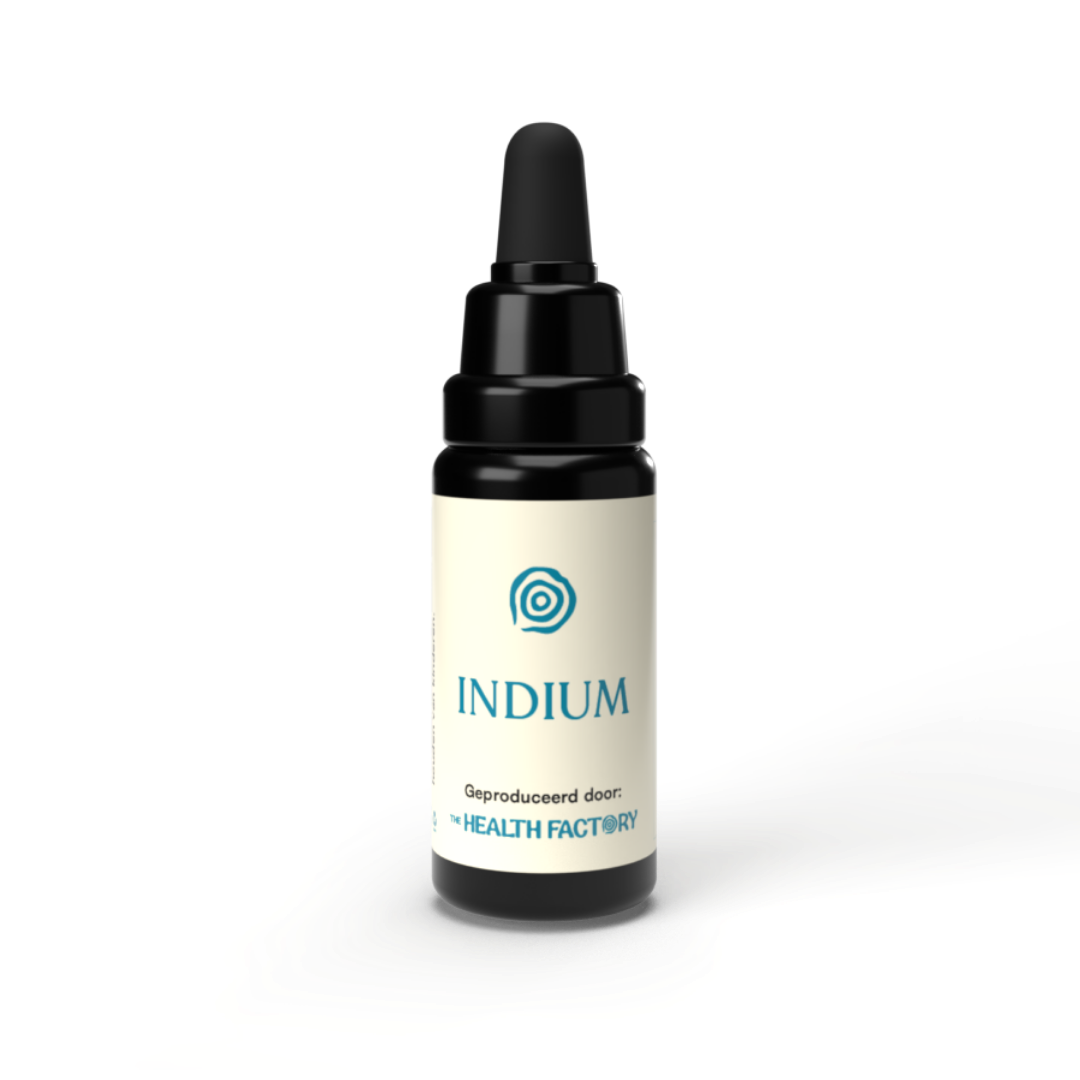
At Morgen is Nu, you will find one pure product containing Indium, from The Health Factory. This product contains indium sulphate dissolved in purified water, at a concentration of 3.4 mg per drop. The formula is simple and pure: it contains no other ingredients.
The liquid is packaged in dark violet glass, which only allows infrared and UV-A light through. This keeps the product fresh and vitalised for longer. The solubility of indium sulphate in water has been chemically established at 539.2 grams per litre at 20°C, a considerable difference compared with other forms of Indium, which are often poorly absorbed.
Please note: under current legislation, this product is suitable for external use only in Europe.
Sources
"Lovely online shop. Morgen is Nu has an extensive, high-quality range. Delivery is almost always quick. We are very happy shopping here."
- Alex
Date of experience: 11 June 2024
View all reviews
About Morgen is Nu - Holistic health shop
Morgen is Nu has a rich history and a unique view of health, which is why we only sell the healthiest, natural products. We believe that a balance between physical, internal and external factors is essential for a long and healthy life. Discover our full philosophy and history.
Telephone: 0341 – 422 850
Our mission is that people with the correct information choose their health products
- Fat-soluble vitamins (A, D, E, K): Take with a meal containing fat.
- Water-soluble vitamins (C, B-complex): Can be taken at any time of the day. B12 is best absorbed on an empty stomach.
When combining supplements, it is important to follow the recommended daily dose for each product and avoid an excessive total intake of certain vitamins or minerals.
Everyone responds differently to supplements. Interactions between different food supplements are also possible. You use and combine supplements at your own responsibility. If you are unsure about combining different food supplements, we recommend consulting a professional.
Pay attention to how your body responds when taking supplements, and consult a doctor or pharmacist if you are taking medication, are pregnant or breastfeeding, or have a medical condition.