
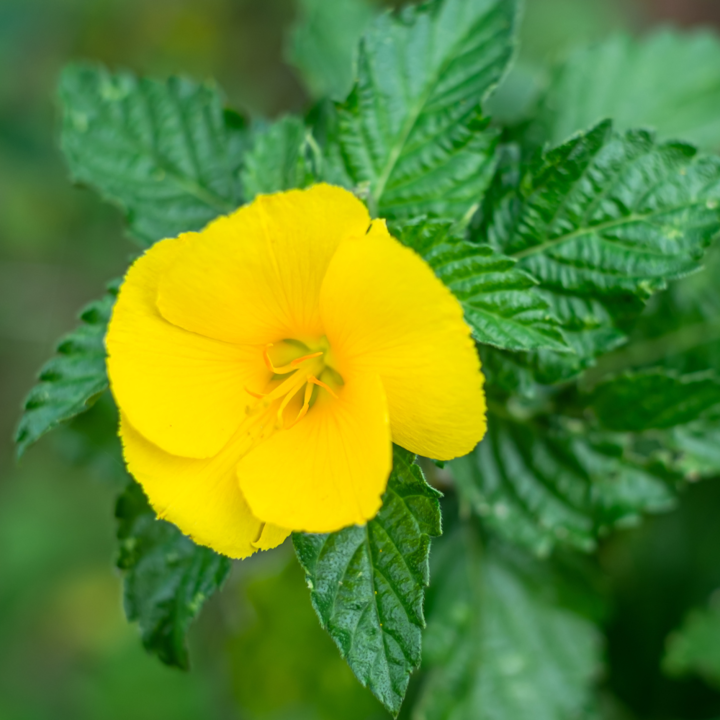
Damiana
Curious about Damiana? This aromatic plant, also known as Turnera diffusa, has been used for centuries. You may know Damiana as a herb, a tea or an extract: on this page, you can read all about the origins, composition and modern uses of this fascinating plant species.
By Stefan, last updated: 28-05-2025
Contents
- Our favourite Damiana extract
- What is Damiana?
- The history and traditional uses of Damiana
- What compounds does Damiana contain?
- Modern uses of Damiana
- Sources
Our favourite Damiana extract
What is Damiana?
Damiana is a small shrub native to South America, Central America, the southern US and the Caribbean. Its botanical name is Turnera diffusa Willd., and in English it is known as Damiana leaf or damiana plant.
Damiana leaves are dried and made into products such as damiana tea, extracts or capsules. You can also find the herb in herbal shops and as an ingredient in natural blends.
The history and traditional uses of Damiana
Damiana has a long and colourful history. In the traditional medicine of indigenous peoples in Mexico and Central America, this aromatic plant was used in rituals and as a fragrant herb. Damiana later made its way to Europe, where it was incorporated into tinctures and herbal blends.
Historical botanical research shows that the use of damiana was closely linked to beliefs about vitality and relaxation. Today, these uses are mainly seen as part of a rich cultural heritage. (source)
What compounds does Damiana contain?
The plant contains an interesting mix of bioactive compounds, including:
- Essential oils such as thymol, cineole and pinenes
- Flavonoids such as apigenin and acacetin
- Terpenes and sesquiterpenes
- Caffeic acid derivatives and small amounts of resins and tannins
This composition has been examined in several laboratory studies, including research into differences in composition between ‘wild’ and cultivated damiana. (source, source)
Modern uses of Damiana
Today, Damiana is mainly used in the form of:
- Dried damiana leaves for tea
- Damiana extract in tinctures
- Damiana capsules as a supplement
Damiana is also popular in natural herbal blends and alternative wellness products. Interestingly, the plant is also being studied in contemporary formulations for its distinctive scent and bioactive profile.
Sources
- Ethnobotany, phytochemistry, and bioactivity of the genus Turnera (Passifloraceae) with a focus on damiana: Turnera diffusa
- Analysis of essential oils from wild and micropropagated plants of damiana (Turnera diffusa)
- Differences in essential oil production and leaf structure in phenotypes of damiana (Turnera diffusa Willd.)
- Antiphotoaging Effects of Damiana (Turnera diffusa) Leaves Extract via Regulation AP-1 and Nrf2/ARE Signaling Pathways
- Damiana (Turnera diffusa) Reduces Adipocyte Cell Differentiation and Ameliorates Myocyte Glucose Uptake
- Role of Oral Supplementation of Damiana (Turnera diffusa) Reduces the Renal Toxicity, Apoptosis and DNA Damage Associated with Amitriptyline Administration in Rats

"Delivery is always quick. I've ordered these products several times before, and they are high quality."
- Catharina Claessens
Date of experience: 9 May 2025
View all reviews
About Morgen is Nu - Holistic health shop
At Morgen is Nu, we work every day to support your health. Guided by a unique vision and years of experience, we select only the purest, highest-quality products. We believe in a holistic approach centred on physical, inner and outer balance.
Telephone: 0341 - 422 850
Our mission is that people with the correct information choose their health products
Damiana leaf is the dried leaf of the Turnera diffusa plant, a small shrub native to Mexico, Central America and the Caribbean. Although the leaf has long been used in various traditions, there are currently no officially authorised health claims for its effects. Scientific research focuses mainly on the leaf’s composition, including essential oils, flavonoids and other bioactive compounds.
Dried damiana is made from the leaves of the Turnera diffusa plant after harvesting. Once dried, the leaves can be used to make damiana tea or prepared in other forms, such as capsules, tinctures or powders. This form is popular because of its long shelf life and wide use in traditional herbal preparations.
The damiana flower is a small, yellow flower that belongs to the Passifloraceae family. The flowers grow on the Turnera diffusa plant, but are used less often than the leaves. In some regions, the flower is also valued for its scent, but most uses of damiana focus on the leaves.
Damiana is generally well tolerated when used in the traditional way, for example as a tea or extract. However, limited clinical information is available about possible side effects. At high doses or with prolonged use, some people may experience mild symptoms. As with any herb, use it in moderation and consult a healthcare professional if you are unsure, take medication, are pregnant or are breastfeeding.
There is not yet clear advice in the scientific Literatuur on the daily intake of damiana extract. Safety depends on the form, dosage, frequency of use and individual sensitivity. It is therefore sensible to start gradually, follow the label and recommended dosage, and consult a professional if you are unsure.
Most health claims are currently linked to vitamins, minerals and fatty acids. For herbs and botanicals, discussions have been ongoing for years. Various on-hold claims have been submitted for this. These are currently awaiting approval by the European Commission. The claims may therefore currently only be used if there is scientific substantiation for the health effect.