
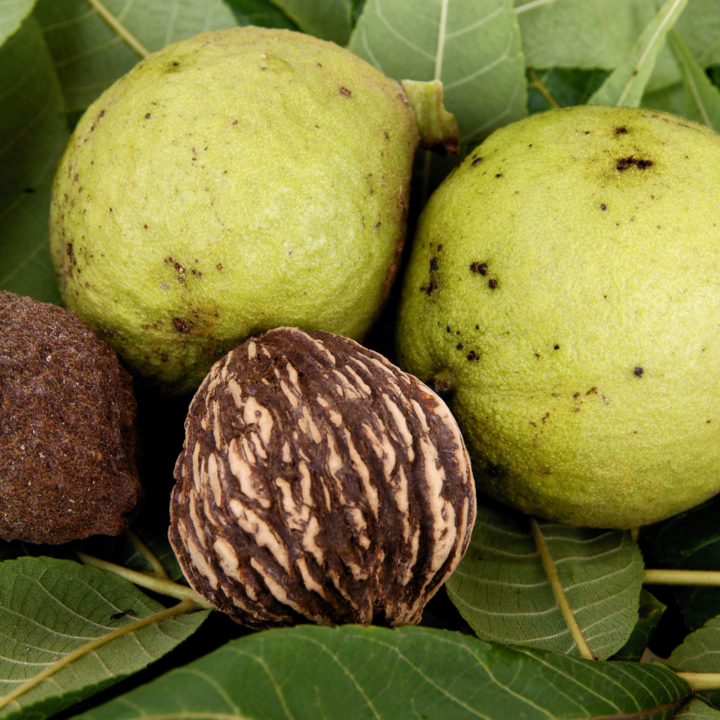
Black Walnut (Zwarte Walnoot)
Black walnut, also known as Juglans nigra, is a tree species that has been valued for centuries for its rich array of constituents. Both the fruit and the hull have been studied for their unique composition. On this page, you can learn about the origins, uses and scientific findings surrounding this distinctive walnut species.
Contents
- Our favourite black walnut tincture
- What is Black Walnut (Zwarte Walnoot)
- What compounds does black walnut contain?
- Traditional uses of black walnut
- Why do people use black walnut?
- Black walnut in herbal cleanses: hype or worthwhile?
- Sources
Our favourite black walnut tincture
What is Black Walnut (Zwarte Walnoot)
Black walnut (Juglans nigra) is a deciduous tree native to North America. It is known for its strong, dark wood. But its most distinctive feature is the thick outer husk surrounding the nut: the black walnut hull. Unlike the common English walnut (Juglans regia), black walnut contains a higher concentration of secondary plant compounds. (source)
The term “Eastern Black Walnut” refers to the wild varieties that grow mainly in the eastern US. Both the nut and the hull are used in extracts, tinctures and plant-based formulas.
What compounds does black walnut contain?
Black walnut is rich in bioactive compounds such as juglone, tannins, flavonoids and polyphenols. (source)
Research also shows that black walnut contains various vitamins, minerals and essential amino acids. These include potassium, magnesium, zinc, iron and glutamic acid. All of these contribute to a broad nutritional profile. (source)
Traditional uses of black walnut
Black walnut tincture, particularly preparations made from the dried hull, has been used in herbal medicine for generations. In North American traditions, hull extracts were used as a natural bitter or for external care. The tincture or powder is still widely used in herbal practice today, usually made from the hull of the nut.
Why do people use black walnut?
Black walnut (Juglans nigra) is attracting increasing scientific interest, mainly because of its rich composition of plant compounds and nutrients.
One notable compound is juglone: a substance the tree produces to inhibit the growth of other plants nearby. This natural defence mechanism is unique and interesting to people too.
Black walnut also contains minerals such as potassium, magnesium, zinc and iron, as well as the amino acid glutamic acid. These are all building blocks that contribute to a well-rounded nutritional profile.
Black walnut in herbal cleanses: hype or worthwhile?
The term ‘black walnut cleanse’ is becoming increasingly common in alternative health circles. Black walnut is sometimes used as part of cleansing programmes. Although it has traditionally been used this way, it is important to remain critical: there is currently no convincing clinical evidence that black walnut is effective as a cleanse.
If you are considering a cleanse using herbs such as black walnut, it is advisable to discuss this with a qualified practitioner or medical herbalist. Not everyone responds to herbal bitters and extracts in the same way. Quality also plays a major role in safety.
Sources
- A Review on the Potential Human Health Benefits of the Black Walnut: A Comparison with the English Walnuts and Other Tree Nuts
- An overview of phytochemicals and potential health-promoting properties of black walnut
- Quantification of Vitamins, Minerals, and Amino Acids in Black Walnut (Juglans nigra)
- Evaluation of the in vitro effects of aqueous black walnut extract on equine mononuclear cells
- Antioxidant potential of Juglans nigra, black walnut, husks extracted using supercritical carbon dioxide with an ethanol modifier

30ml | Liquid | United States of America
"Very friendly customer service! On several occasions, I've received really helpful and friendly advice and answers to my questions about products. And I'm pleased to say that orders are delivered quickly and with care."
- Angelique Banis
Date of experience: 16 May 2025
View all reviews
About Morgen is Nu - Holistic health shop
At Morgen is Nu, we work every day to support your health. Guided by a distinctive vision and years of experience, we select only the purest, highest-quality products. We believe in a holistic approach that centres on physical, inner and outer balance.
Telephone: 0341 – 422 850
Our mission is that people with the correct information choose their health products
Black walnut has a long history of traditional use in various cultures. The bark, hull and leaves of the tree are used to make tinctures, powders and extracts. Although the plant is valued in herbal medicine for its rich botanical composition, there are currently no officially approved health claims for black walnut. Its use is therefore mainly based on tradition and personal preference.
The black walnut tree (Juglans nigra) is native to eastern and central North America. It is less commonly seen in Europe and is considered a fairly rare species there. In commercial cultivation, black walnut is less common than English walnut, partly because of its harder husk and longer growing period.
Black walnut trees can grow up to 30 metres tall and develop an impressive crown. They grow best in deep, well-drained soil with plenty of sunlight. In the wild, the species is found from south-eastern Canada to the southern United States. The tree spreads slowly and is sensitive to soil conditions, which limits its range to suitable growing areas.
Black walnut tincture is usually taken in small amounts diluted with water. The exact dosage may vary from product to product. Always follow the instructions on the label of the specific supplement. If in doubt, it is advisable to consult a qualified professional, especially for long-term use or if you are taking medication.
Black walnuts (Juglans nigra) and ordinary walnuts (Juglans regia) belong to the same family, but differ in several ways:
- Flavour: black walnuts have a stronger, earthier and more intense flavour than ordinary walnuts.
- Husk: the husk of black walnuts is much harder and more difficult to crack.
- Use: black walnuts are often used for extracts or oils, while ordinary walnuts are more commonly eaten as a snack or used in baking.
- Cultivation: Juglans regia is grown commercially worldwide; Juglans nigra is mainly found in the wild or grown by specialist growers.
Black walnuts stand out for their tough husks, intense flavour and abundance of plant compounds in the husk. They have been used traditionally for generations and are less common than ordinary walnuts. The tree's wood is also highly sought after for its dark colour and durability. This combination of qualities makes the black walnut a distinctive tree with a wide range of culinary and traditional uses.
Black walnut tincture is generally well tolerated when used normally and within the recommended dosage. However, some people may experience sensitivity, for example if they exceed the recommended dose or use it for a prolonged period. Interactions may also occur when taken alongside certain medicines. It is therefore sensible to consult a qualified professional if you are unsure, and always build up use gradually and carefully monitor how your body responds.