

Barley Grass (Barley Grass Juice)
Looking to buy barley grass? Barley grass, also known in its juice form as barley grass juice, is a young green plant packed with natural nutrients. Find out what makes this green powerhouse so special.
By: Stefan, last updated: 18-06-2025.
Contents
- Our favourite barley grass supplements
- What is barley grass (barley grass juice)?
- Traditional use of barley grass
- The nutrients in barley grass
- The difference between barley grass and barley grass juice
- Sources
Our favourite barley grass supplements
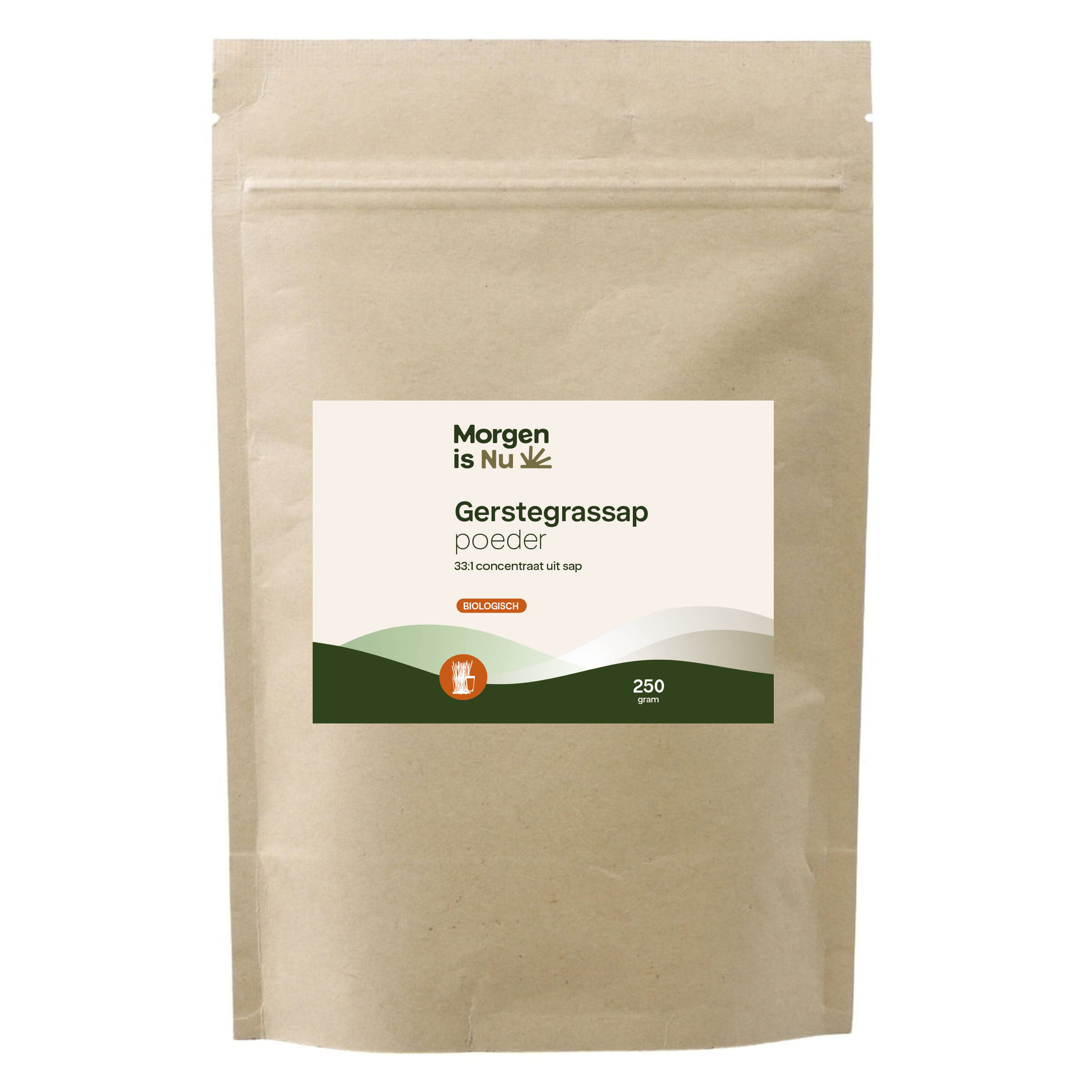
- Bio Gerstegrassap Poeder by Morgen is Nu
- Barley Grass Juice Powder by Vimergy
- Barley Grass Juice Caps by Vimergy
What is barley grass (barley grass juice)?
Barley grass is the young green leaf of the barley plant (Hordeum vulgare), harvested in the early stages of growth, before grains form. At this stage, the plant contains its highest concentrations of vitamins, minerals, enzymes and chlorophyll. (source) It is usually consumed as dried juice (barley grass juice powder) or as a ground powder (barley grass powder), and is known worldwide as a functional ‘green food’.
Unlike a fully mature grain, young barley (barley grass) contains a complete spectrum of micronutrients, amino acids and other potent compounds. This is the point when the plant reaches its peak vitality. This unique composition makes it popular with people looking for natural, plant-based support for their daily diet.
Traditional use of barley grass
Barley grass has a long history of use, particularly in Asian cultures such as Japan. There, it has been used for decades as part of a nourishing diet. (source)
In the United States, barley grass became better known with the rise of ‘Green Barley’ supplements: freeze-dried juice from young barley grass grown under carefully controlled conditions.
Barley grass is also highly regarded in modern herbal medicine. This is due to its impressive nutritional profile and the fact that the young leaves are harvested when the plant reaches its peak nutritional value. This harvesting method fits within a broader tradition in which young plants are seen as a potent addition to the daily diet. (source)
The nutrients in barley grass
Barley grass is particularly rich in essential nutrients. Below is an overview of its main components:
- Vitamins and minerals: Rich in vitamins C, E, B1, B2, B6, B12, folate (5-MTHF), potassium, calcium, magnesium, iron and zinc.
- Chlorophyll: More than 500 mg per 100 g dry weight; naturally present in young green leaves.
- Aminozuren and GABA: Contains all essential amino acids and GABA (γ-aminobutyric acid).
- Enzymes: Including superoxide dismutase (SOD) and catalase.
- Flavonoids and polyphenols: Contains saponarin, lutonarin and ferulic acid, plant compounds that occur naturally in young leaves.
- Dietary fibre: Up to 29% fibre, mainly insoluble.
The difference between barley grass powder and barley grass juice powder
Although barley grass powder and barley grass juice powder (also written as barleygrass juice powder) are often treated as the same thing, they are two different products. Both are made from young blades of the barley plant (Hordeum vulgare), but the production process differs significantly.
Barley grass powder is made by drying and grinding the whole leaf, including the fibre-rich cellulose. Because humans cannot digest cellulose, some of this powder remains unused by the body. This powder is generally lighter in colour.
Barley grass juice powder, on the other hand, is made from the pressed juice of the grass, which is then dried. This removes the indigestible cellulose, resulting in a higher concentration of absorbable nutrients and a deeper, dark green colour.
Sources
- Source 1: Evaluation of Barley Grass as a Potential Source of Some Nutritional Substances
- Source 2: Barley Grains and Barley Grass: Nutritional Value and Therapeutic Potential
- Source 3: UTILIZATION OF YOUNG GREEN BARLEY AS A POTENTIAL SOURCE OF SOME NUTRITION SUBSTANCES
- Source 4: Preventive and Therapeutic Role of Functional Ingredients of Barley Grass for Chronic Diseases in Human Beings


250 grams, 500 grams | Powder | United States of America
Bundle | United States of America, Finland, Ireland

250 grams | Powder | United States of America
"Great service and quality! My order arrived really quickly, brilliant! The products are quite pricey, but you know exactly what you're putting into your body, and that's worth it. If you care about your body and only want the best, I really recommend Morgen is Nu!"
- Mrs Granville
Date of experience: 28 January 2025
View all reviews
Our vision at Morgen is Nu: holistic health and wellbeing
At Morgen is Nu, we work every day to support your health. Guided by a unique vision and years of experience, we select only the purest, highest-quality products. We believe in a holistic approach that puts physical, inner and outer balance at its heart.
Telephone: 0341 – 422 850
Our mission is that people with the correct information choose their health products
Barley Grass is a young green plant that is naturally rich in vitamins, minerals, chlorophyll, enzymes, fibre and amino acids. Many people add it to their daily diet because of its broad range of nutrients and because it is easy to use as a powder or juice.
Barley grass is a natural source of nutrients such as vitamin C, folate, iron, potassium, chlorophyll and various enzymes. It is often used to supplement a varied diet that includes plant-based foods.
Barley is one of the oldest cereal grains in the world. Barley Grass refers specifically to the young green leaves of the barley plant (Hordeum vulgare), harvested before the grain forms.
Barley grass powder is generally well tolerated. In some cases, people may experience a mild reaction, such as bloating or a change in bowel habits. Are you allergic to grasses or do you take medication? If so, always check with a healthcare professional.
Wheatgrass and barley grass look similar, but come from different grains: wheat and barley respectively. Both are harvested when young and contain a wide range of nutrients, but the exact mix of vitamins, enzymes and phytonutrients varies by plant species and growing period.
The recommended amount may vary from product to product. Always check the label for the correct usage. It is best to start with a small amount and gradually increase it. Unsure about the dosage or how to use it? Please feel free to contact us. We will be happy to help.