

Before we begin
There are strict rules about what can and cannot be said about food supplements. We are bound by this European legislation, so we choose our words carefully. Medical claims, for example, are not permitted, and health claims about botanical ingredients must include a disclaimer. We also do not always list all scientific sources, as we are responsible for the exact wording we refer to.
Read more about how we approach health claims and regulations here.
Magnesium is one of the most important minerals in your body. It is involved in countless processes and supports your energy, muscles and nervous system, among other things. Yet things often become confusing when you start looking into supplements. Why are there so many different forms?
The answer is actually simpler than it seems. The mineral itself is always the same. The difference lies in the form in which it is supplied. In this blog, we help make sense of it all. We explain where magnesium comes from, the forms it occurs in and how to understand the differences between supplements.
Contents
- Your body cannot make its own magnesium
- What magnesium does in your body
- 1. Magnesium compounds: the traditional supplement form
- 2. Natural magnesium from plants and algae
- 3. Innovation: nano and ionic magnesium
- The full picture
Your body cannot make its own magnesium
Magnesium is an essential mineral. This means your body cannot produce it itself. You depend entirely on what you get through food or supplements.
Magnesium occurs naturally in foods such as green leafy vegetables, nuts, seeds, pulses and wholegrain products. Even so, not everyone finds it easy to get enough from these foods every day. In such cases, taking a supplement can be a considered way to top up your intake.
What magnesium does in your body
Magnesium is found in your bones, muscles, nerves and cells. It is involved in your body's energy production and in the way your muscles and nerves work together.
This is also reflected in the permitted health claims:
- Magnesium supports the body's natural energy production
- Magnesium helps reduce tiredness and fatigue
- Magnesium contributes to normal muscle function
- Magnesium supports the functioning of the nervous system
- Magnesium contributes to electrolyte balance
- Magnesium contributes to the maintenance of strong bones
- Magnesium is needed to maintain strong teeth
- Magnesium supports the process of cell division
- Magnesium helps the body build proteins
- Magnesium contributes to concentration
One important thing to know: whichever form you take, magnesium is ultimately absorbed by your body as a magnesium ion (Mg²⁺). This is the active form your cells use. So the differences between supplements are not about a different kind of magnesium, but about how the mineral is made available to your body.
1. Magnesium compounds: the traditional supplement form
A familiar way to supply magnesium is as a compound. Here, magnesium is bound to another substance, such as an organic acid or an amino acid. This is necessary because pure magnesium as a mineral is not stable enough to use on its own in a capsule. Binding it makes it easier to handle and absorb. Each compound has its own characteristics in terms of solubility and tolerability.
Commonly used compounds
Magnesium citrate
A readily soluble form often chosen as a basic, general-purpose supplement.
Magnesium (bis)glycinate
Bound to the amino acid glycine. Known as a gentle form that is often well tolerated, making it popular for daily use.
In practice, the terms glycinate and bisglycinate are often used interchangeably. Essentially, they refer to exactly the same compound, in which magnesium is bound to glycine. The only difference is the name.
Magnesium malate
Bound to malic acid. Often chosen by people with an active lifestyle.
Magnesium taurate
Bound to taurine. Less common, but deliberately chosen by people looking for specific combinations.
Magnesium L-threonate
A newer form that is attracting a lot of attention. This form has been shown to cross the blood-brain barrier. This is why it is mainly used for memory and cognitive function.
Magnesium oxide
A simple, inexpensive form with a high percentage of elemental magnesium per gram, but absorbed less efficiently than more soluble compounds.
The same applies to all compounds: magnesium is released in the digestive tract and absorbed as a magnesium ion.
2. Natural magnesium from plants and algae
Alongside compounds, there is also magnesium derived from natural sources such as plants and algae. Magnesium occurs naturally in soil and seawater. Plants absorb it through their roots. In plants, magnesium is actually the central element in chlorophyll, the molecule that gives plants their green colour.
When magnesium is extracted from algae, for example, the mineral is embedded in a natural matrix. This means it occurs together with other trace elements and plant substances.
For people who deliberately choose ingredients of natural origin, this is an important consideration. It is not a different kind of magnesium, but a matter of how it is incorporated and concentrated in nature.
This form is often chosen as a basic daily supplement precisely because it stays close to its natural origins.
3. Innovation: nano and ionic magnesium
Alongside traditional compounds and natural sources, there are also innovative production methods. These focus less on using a different substance and more on changing the structure or form in which magnesium is supplied.
Ionic magnesium
Ionic magnesium usually refers to magnesium dissolved in water, where it is already present as magnesium ions. The idea is that the mineral is immediately available. In practice, however, many readily soluble magnesium compounds are also converted into ions in the stomach. Ionic magnesium is used both internally and externally, for example as drops or sprays.
Nano magnesium
Nano magnesium refers to extremely small particles of magnesium. Reducing the particle size is intended to optimise solubility and availability. This is an innovative approach focused on production technology. The mineral itself does not change, but the structure in which it is supplied does. For people interested in technological developments in supplements, this may be an interesting option.
The full picture
Looking at the full picture, there are three approaches: the traditional compound, the natural source and the innovative form. But in every case, your body cannot make its own magnesium. You depend on what you take in. And regardless of the form, your body ultimately uses the same magnesium ion.
Choosing magnesium does not have to be complicated. It is not about which name sounds the most impressive, but which form suits your body and your outlook.
At Morgen is Nu, we believe it is important for you to know the whole story. That includes the compounds, their natural origins and innovative developments. This helps you make an informed choice.

Products we stand behind
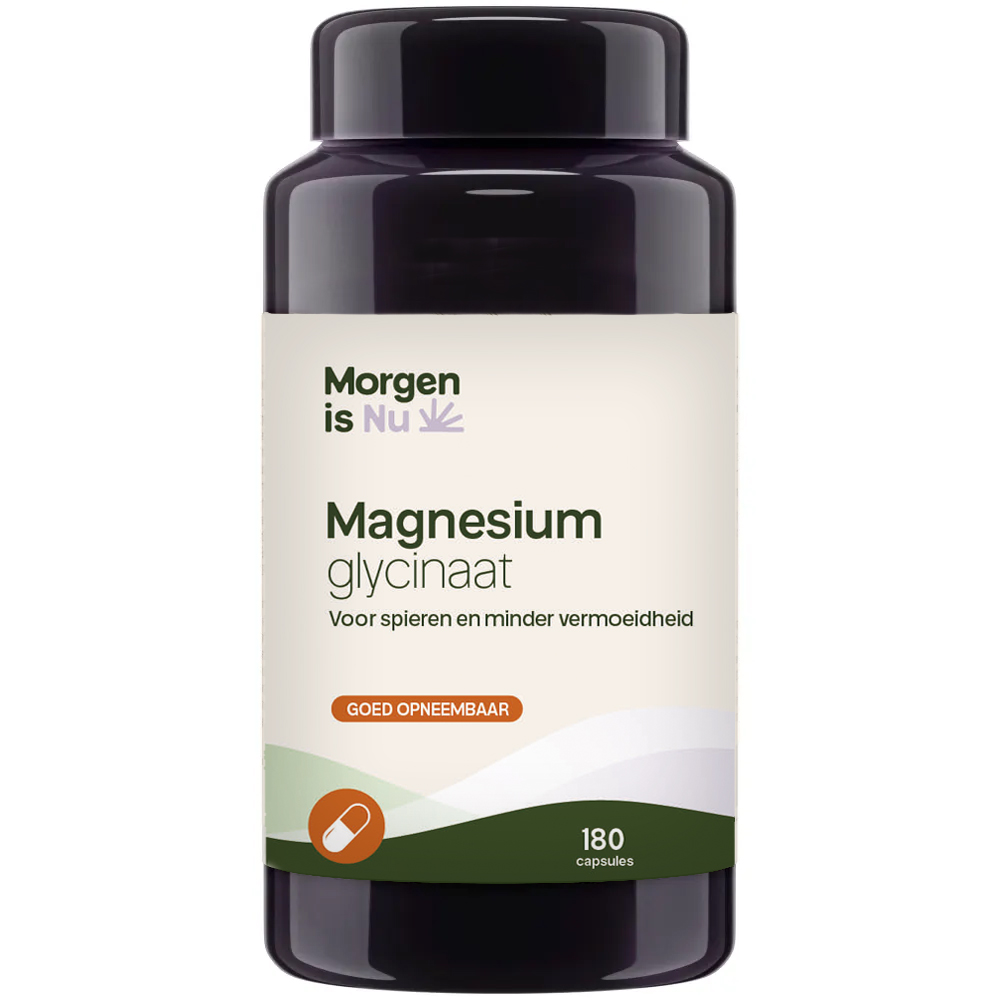
180 capsules | Capsules | Magnesium | (Bis)glycinate

60 capsules | Capsules | Magnesium | Natural source | The Netherlands

1000ml, 500ml | Liquid | Magnesium | Nano | The Netherlands
