

A quick note before we begin
There are strict rules about what can and cannot be said about food supplements. We are bound by this European legislation, so we choose our words carefully. Medical claims, for example, are not permitted, and health claims about botanical ingredients must carry a disclaimer. We also do not always list all scientific sources, because we are responsible for the exact wording we refer readers to.
Read more here about how we handle health claims and regulations.
Would you like to know more about Cat’s Claw (cat’s claw) and what it is used for? This impressive climbing plant, also known by its botanical name Uncaria tomentosa, comes from the rainforests of South America. Indigenous peoples have used this tropical vine for generations. Scientific interest in this distinctive herb is now growing too. Its positive effect on our immune system in particular is the subject of considerable research*.
At Morgen is Nu, we have been fans of Cat’s Claw for years, and with good reason. It is mainly the potent compounds in the bark that make this plant so special. But what makes these compounds so interesting for your body and health? In this blog, we take a closer look at Cat’s Claw.
Contents
- What exactly is Cat’s Claw?
- Please note: not all cat’s claw is the same
- Traditional uses of Cat’s Claw
- Cat’s Claw and our immune system
- Why we value this natural source of support
What exactly is Cat’s Claw?
Cat’s Claw is a tropical climbing plant native to the rainforests of South and Central America. You may know it as cat’s claw, samento, or by its botanical name Uncaria tomentosa. The name ‘Cat’s Claw’ was not chosen at random: the plant has small, hook-shaped thorns on its stems that look very much like a cat’s claws. The vine uses these hooks to cling to trees and climb many metres high, sometimes reaching tens of metres. Its botanical name also refers to this striking feature. Uncaria comes from the Latin word uncinatus, meaning ‘hooked at the tip’.
Please note: not all cat’s claw is the same
The full botanical name of the plant discussed here is Uncaria tomentosa. The word tomentosa refers to the fine hairs on the underside of the leaf. This feature distinguishes it from other species. There is also a related species, Uncaria guianensis, which does not have these hairs. Confusingly, this plant is also commonly called ‘cat’s claw’. It is important to know the difference, though.
Both traditional healers from Peru and recent scientific studies indicate that Uncaria guianensis is less effective than Uncaria tomentosa. This is because the active compound isopteropodine is present in much lower concentrations in guianensis.
Traditional uses of Cat’s Claw
Indigenous peoples in the Amazon region have used Cat’s Claw in their traditional medicine for centuries. They boil the bark and roots to make teas or extracts to support various aspects of health. Sometimes the liquid from the stem is also drunk on its own as a refreshing and revitalising drink.
This traditional use has also attracted scientific attention. The first studies into its active compounds and benefits were carried out in France as early as 1952, and Cat's Claw continued to attract considerable interest from researchers in the 1970s, 1980s and 1990s.
Cat’s Claw and our immune system
Cat’s Claw has many uses, but is best known for its influence on the immune system*. This is due to the unique plant compounds found in its bark and roots. These bioactive compounds provide support in the following ways:
1. Supporting the non-specific immune system*
Firstly, it influences how our non-specific immune system functions. This is the body’s rapid, general defence response. Special white blood cells play a role here: they detect foreign substances, destroy bacteria and viruses, and clear away damaged cells. This process is called phagocytosis.
The compounds in Cat’s Claw that support this mechanism belong to a group called pentacyclic oxindole alkaloids. The most important of these are pteropodine, isomitraphylline and isorhynchophylline.
2. Supporting the specific immune system*
Cat’s Claw also has an effect on the specific immune system. This part of the body’s defences focuses on recognising and eliminating specific pathogens. T and B lymphocytes play a central role here. When these cells are activated, they develop into specialised immune cells that target invaders or produce antibodies.
Here too, active compounds belonging to the pentacyclic oxindole alkaloids (in this case alloisopteripodine and allopteripodine) are responsible for this effect.
Why we value this natural source of support
At Morgen is Nu, we value this pure source of support from nature. We find it remarkable that a plant used for centuries in the Amazon region is now being rediscovered. And appreciated for what it can do. We will continue to follow further research with interest.
However you use Cat’s Claw (as a tincture, tea or extract), it is a plant that can support you in a pure and natural way.
*Health claim awaiting European authorisation
Written by Lisanne - last updated 01-05-2025
Cat's Claw products we believe in
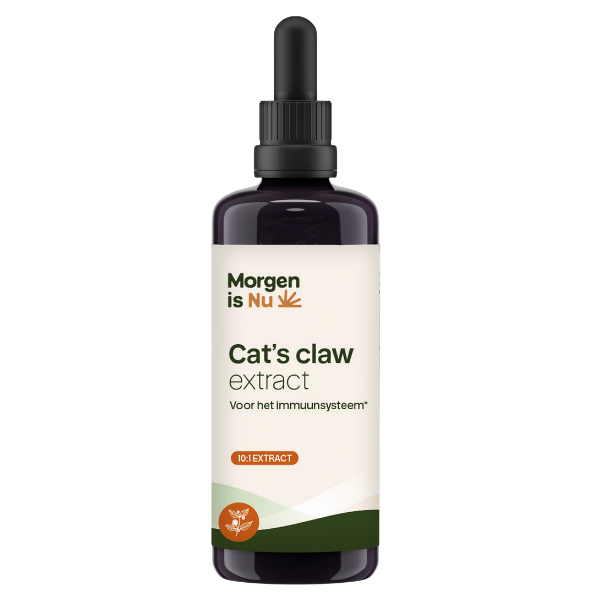
100ml | Liquid | Cat's Claw | Germany

60ml | Liquid | Cat's Claw | United States of America

