
19,95
500ml | Liquid | Canadian Wild Blueberry | Canada
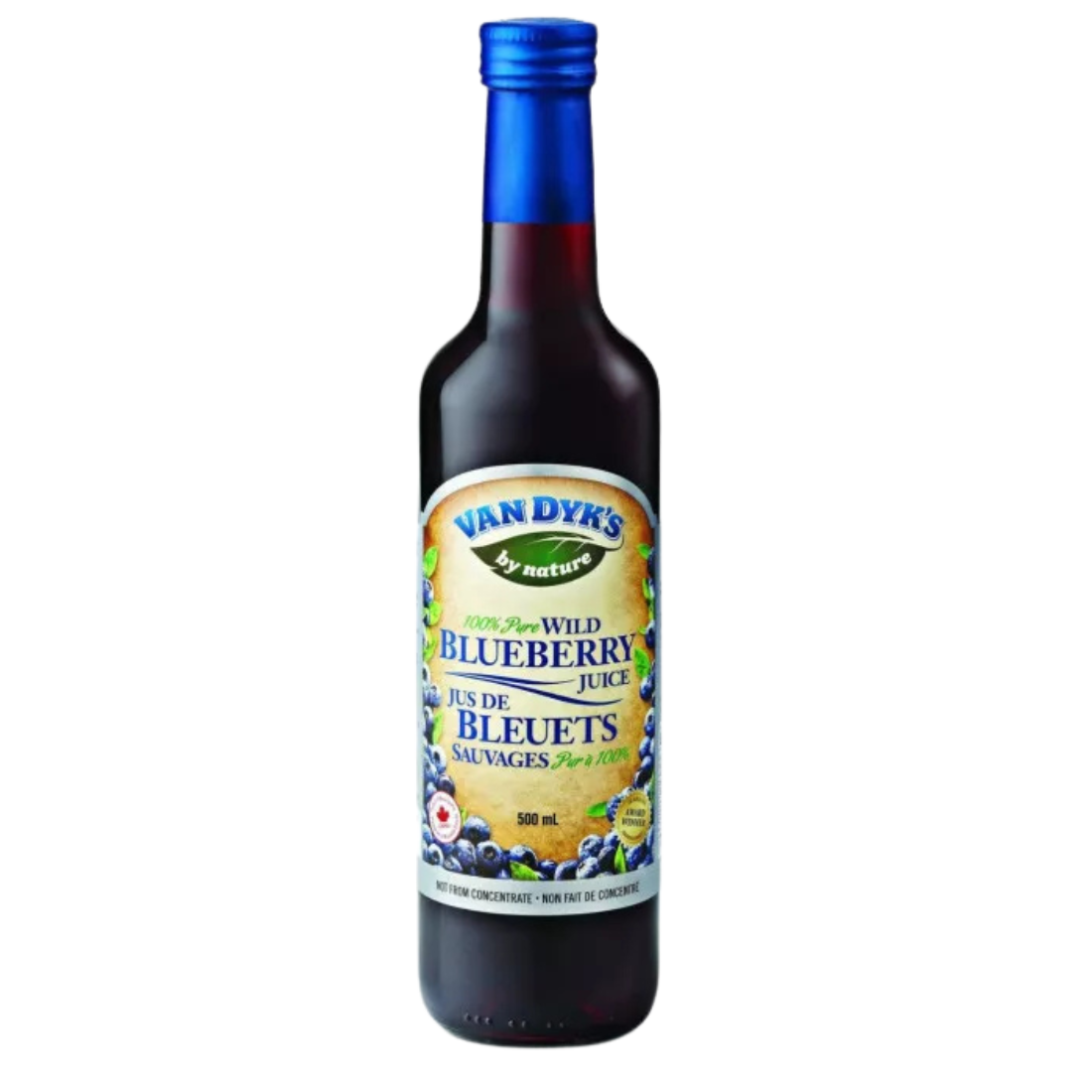
Wild Blueberry Juice Van Dyk's
Enjoy the power of over 2,000 wild blueberries in every bottle of Van Dyk's Wild Blueberry Juice, made from the Canadian Vaccinium angustifolium blueberry. This juice combines unmatched nutrition with a delicious, natural taste. Made entirely from 100% wild blueberries, with no concentrates or additives—all natural, just the way it should be.
The Canadian Vaccinium angustifolium
This juice is made from wild blueberries from Canada, also known as lowbush blueberries. These wild-growing berries are of a much higher quality than the cultivated highbush varieties that you often find in the supermarket. What makes these berries so special is their high concentration of active substances, such as flavonoids (particularly flavanol glycosides and anthocyanin glycosides). Research by theUSDA Human Nutrition Center (HNRCA)it turns out that wild blueberries contain more flavonoids than 40 other types of fresh fruits and vegetables. To ensure the safety of the juice and to preserve the nutrients as much as possible, it is briefly heated via a flash pasteurization process. With this juice you will definitely get a pure and nutritious boost.
About Van Dyk's
Van Dyk's is a family owned business located in the quiet village of Caledonia, Canada. Over 60 years ago, Cornelius and Henrica Van Dyk emigrated from the Netherlands to Canada in search of new opportunities in agriculture. Since then, the family has dedicated themselves to growing the best wild blueberries in the region. With a philosophy of letting nature do its thing, they support the natural growth process of the berries and work with honeybees for pollination. By resting the berries every other year, they ensure stronger plants and healthier fruit.
Ingredients
100% pure Canadian wild blueberry juice (Vaccinium angustifolium)
Nutritional values
Composition per 250ml | %RI* | |
| Energy | 110 kcal/ 460.5 KJ | 5.5% |
| Fats | 0 gr | 0% |
| Carbohydrates | 28 gr | 10.8% |
| - of which natural sugars | 22 gr | 24.4% |
| Proteins | 0 gr | 0% |
| Salty | 0 gr | 0% |
| Potassium | 140 mg | 7% |
* Reference intake
 Gluten
Free
 Soy
free
 Vegan
 GMO
Free
 Alcohol-free
Label information
| Contents | 500ml |
|---|---|
| Storage advice | Store dry, closed and at room temperature. Shake well before use. After opening, keep refrigerated and use within 7 days. Keep out of reach of young children. |
| Distributor | Morgen is Nu BV, Daltonstraat 42, 3846 BX Harderwijk, The Netherlands |
| Country of Origin | Canada |
 Need help? We're here for you
Our mission is that people with the correct information choose their health products
Not quite. In Dutch, the terms for wild blueberries and blueberries are often used interchangeably, but there are different species within the Vaccinium genus. “Blueberry” usually refers to the larger, cultivated variety found in supermarkets. These are often highbush species, such as Vaccinium corymbosum. These berries are relatively large, pale inside and have a milder flavour.
“Wild blueberry” more often refers to varieties that grow in the wild. A well-known example is the European bilberry (Vaccinium myrtillus), but the Canadian wild lowbush blueberry (Vaccinium angustifolium) also falls into this group. These wild varieties are usually smaller, darker in colour and have proportionally more skin.
Although they are related, they differ in how they grow, as well as in appearance, flavour and composition.
Wild blueberries are known for their rich natural composition. They naturally contain various plant compounds, including anthocyanins and other polyphenols. These are pigments that give the berries their deep blue-purple colour. Blueberries are also known, among other things, to be good for blood vessels* and to contribute to the maintenance of normal vision*.
Wild varieties, such as the Canadian lowbush blueberry (Vaccinium angustifolium) or the European bilberry (Vaccinium myrtillus), are also smaller and have a relatively higher proportion of skin. The skin is where many of the natural compounds produced by the plant are found.
*Health claims awaiting European approval.
Bilberries are the fruit of the Vaccinium myrtillus shrub, the European wild bilberry. They are small and purplish-blue, and have been used for centuries for their flavour and composition. Unlike blueberries, bilberries are not cultivated but are mainly picked in the wild.
Yes, wild blueberries are generally safe to eat, provided you are certain they are Vaccinium myrtillus (European bilberry) or Vaccinium angustifolium (Canadian blueberry) and come from a clean, uncontaminated environment. Always take care not to confuse poisonous berries with edible varieties. Buying wild blueberries as a supplement or powder? At Morgen is Nu, you can choose products that are safe and quality-checked.
Wild blueberry (Vaccinium myrtillus or Vaccinium angustifolium) is generally well tolerated and safe when used as directed. In rare cases, high doses may cause mild stomach discomfort. Do you take medicines such as blood thinners or blood sugar-lowering medication? Consult a healthcare professional first.


