A quick note before we begin
Strict rules govern what can and cannot be said about food supplements. We are bound by this European legislation and therefore word our content carefully. Medical claims, for example, are not permitted, and health claims about botanical ingredients must carry a disclaimer. We also do not always list all scientific sources, because we are responsible for the exact wording we refer readers to.
Read more here about how we handle health claims and regulations.
Lactoferrin is a protein that occurs naturally in the human body, including in breast milk, saliva and tears. It belongs to the group of iron-binding proteins and has been the subject of scientific research for many years. But how exactly does this binding to iron work? And what happens to lactoferrin when you consume it through food or supplements?
Contents
- What is lactoferrin?
- Where does lactoferrin occur naturally?
- Lactoferrin in breast milk and colostrum
- Lactoferrin and iron: how does it work?
- What happens to lactoferrin during digestion?
- Lactoferrin in food and supplements: what is the difference?
What is lactoferrin?
Lactoferrin is a natural protein that belongs to the transferrin family, a group of proteins that can bind iron. Its name refers to two characteristics: lacto means milk and ferrum is the Latin word for iron.
Lactoferrin is what is known as a glycoprotein. This means that the protein consists of amino acids with carbohydrate chains attached. It has a distinctive three-dimensional structure with two parts, each of which can bind an iron ion.
Lactoferrin was first discovered in cow's milk. We now know that the protein also occurs in various other places in the bodies of humans and animals. Scientists are particularly interested in the way lactoferrin binds iron and can release it again.
Where does lactoferrin occur naturally?
Lactoferrin is best known as a component of milk, but it also occurs elsewhere in the body. It is found, for example, in saliva, tears and various other bodily secretions.
Certain white blood cells, known as neutrophils, also contain lactoferrin. In these cells, the protein is stored in small structures called granules. The amount of lactoferrin varies between bodily fluids. Breast milk, for example, contains fairly high concentrations, while the amounts in saliva are much lower.
Lactoferrin in breast milk and colostrum
Breast milk is one of the richest natural sources of lactoferrin. Colostrum, the first milk mammals produce after giving birth, contains relatively large amounts of this protein.
Colostrum is also known as first milk and has a different composition from the milk produced later. During lactation, the composition of breast milk changes and the concentration of lactoferrin generally decreases.
This first milk is naturally intended for newborn young. Out of respect for this natural process, we at Morgen is Nu have made a conscious decision not to offer colostrum supplements.
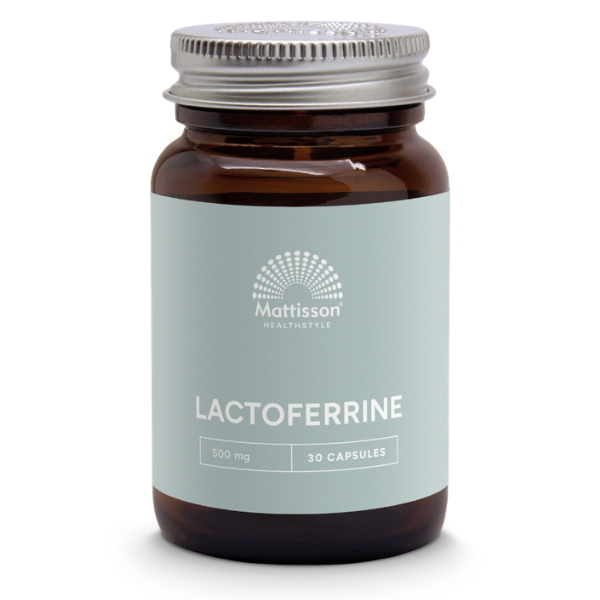
Lactoferrin in supplements does not have to come from colostrum. It is usually extracted from regular cow's milk or whey.
Lactoferrin and iron: how does it work?
One of the most notable properties of lactoferrin is its ability to bind iron. But how exactly does this work?
Iron occurs in different forms. Lactoferrin can specifically bind to iron ions in the form of Fe³⁺. The protein has two binding sites for this, one in each part of its structure.
Depending on the amount of iron bound, we distinguish between two forms:
Apo-lactoferrin
Lactoferrin with no iron bound to it.
Holo-lactoferrin
Lactoferrin with both iron-binding sites occupied.
When lactoferrin binds iron, the protein's shape changes slightly. The parts that hold the iron effectively close around the iron ion. This binding is not permanent. Under certain conditions, lactoferrin can release the iron again. This depends, among other things, on the acidity of its surroundings.
What happens to lactoferrin during digestion?
When you consume lactoferrin through food or a supplement, it enters the digestive tract just like other proteins. In the stomach, it encounters stomach acid and digestive enzymes, including pepsin. This can change the protein's structure and partially break lactoferrin down into smaller protein fragments. These fragments are called peptides.
However, lactoferrin is not always broken down completely. Research simulating digestion in a laboratory shows that some of the protein can remain intact under certain conditions.
How much lactoferrin is broken down depends on several factors. These include acidity, the enzymes present and the amount of iron bound to the protein.
Lactoferrin in food and supplements: what is the difference?
Lactoferrin occurs naturally in the milk of humans and other mammals. The concentration in cow's milk is usually lower than in human breast milk.
Bovine lactoferrin is often used in food supplements. Bovine means originating from cattle. The protein is extracted from cow's milk or whey and then purified.
Human and bovine lactoferrin are very similar in structure, but they are not exactly the same. Differences include the amino acid sequence and the carbohydrate chains attached to the protein.
The composition of lactoferrin supplements can also differ. The amount of lactoferrin per capsule varies, as do the raw materials and production methods used. Manufacturers may also use acid-resistant capsules in supplements, which slow down this process.
Lactoferrin is sensitive to certain conditions during processing, such as heat. The way the protein is extracted and processed can therefore affect its original structure.
Products we stand behind