
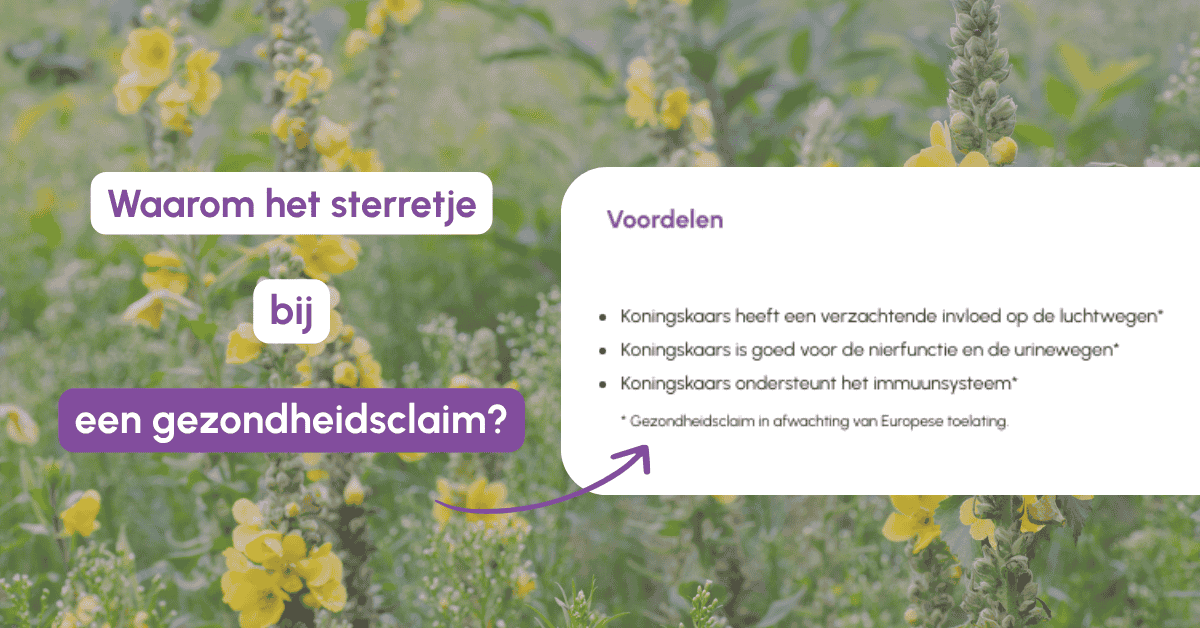
You may occasionally see it on our website or on the label of a herbal supplement: a health claim followed by an asterisk. For example:
“Lemon balm contributes to mental wellbeing*”
or
“Mullein has a soothing effect on the respiratory tract*”
That asterisk refers to a disclaimer: Health claim awaiting European approval. This statement relates to a particular group of health claims, known as on-hold botanical claims. Here, we explain exactly what that means.
What types of claims are there?
You will find various types of claims on supplements and other health products. A nutrition claim tells you something about a product’s composition, for example that it is high in fibre or contains vitamin C. A health claim goes a step further: it links a substance in the product to a specific function in the body, such as “vitamin C contributes to the normal function of the immune system”.
Approval from the European Commission is required before these health claims can be used. The Commission calls on the European Food Safety Authority (EFSA) for this. This is an independent authority that assesses whether there is sufficient scientific evidence for the safety of a particular substance.
It also assesses whether there is sufficient scientific evidence for a substance’s effects. A claim may only be used officially once EFSA has established that the ingredient is safe for healthy people and does contribute to a specific health function, and the European Commission has issued a positive assessment on that basis.
But not all claims have been assessed yet. An exception applies to one specific group: the so-called on-hold botanical claims.
What are on-hold claims?
For vitamins and minerals, most assessments have now been completed, and further applications and assessments continue to be added. But this is not the case for plants and herbs (also known as botanicals). Many of these substances have a long tradition of use in natural medicine, but are difficult to assess using current scientific methods.
That is why, in 2010, the European Commission decided to suspend the assessment of thousands of herbal claims for the time being. These claims have been submitted, but have not yet been approved or rejected. They are ‘on hold’: awaiting assessment.
As a temporary solution, manufacturers and suppliers may continue to use these claims, provided they are accompanied by a clear disclaimer. Each manufacturer or supplier must also substantiate any health claim used with scientific research in the product dossier.
Take, for example, the on-hold claim ‘Astaxanthin contributes to the maintenance of normal skin*’. This was submitted by France before 2010, with an associated dosage of 4 mg per day. Various scientific studies are available that support this claim at the stated dosage. We have included these studies in the product dossier as supporting evidence. This allows us to use the on-hold claim for products containing astaxanthin at this dosage.
As you can see, the use of on-hold claims for botanicals is therefore subject to clear conditions.
Why was the assessment of botanicals suspended?
The suspension stems from a fundamental debate about evidence. Medicines are subject to a separate set of rules that also takes traditional use into account: if a herb has been used for a particular effect for thirty years, this may count as evidence of efficacy [source]. No such exception exists for food supplements.
As a result, herbal claims on supplements were required to be supported by large-scale, modern clinical studies. But for natural substances, this is often not feasible in practice, because of the complexity of plant compounds, the lack of patents and the high costs of research and registration.
What does this mean in practice?
In practice, we are left with an inconsistent situation in which a herbal medicine may claim an effect, while exactly the same extract in supplement form may make no such promise or must use a disclaimer to do so. Many manufacturers, scientists and consumers consider this unfair. They advocate a system in which traditional use can also be taken into account as credible evidence for supplements. So far, however, no agreement on this has been reached in Europe.
Until then, the rules remain as they are. This also means that much valuable knowledge about plants, herbs and their possible effects is not yet 100% recognised under current legislation. We believe there is room for improvement, and that traditional wisdom and modern science should be able to complement rather than exclude one another.
Written by Lisanne - last updated 07-08-2025
