Before we begin
Strict rules govern what can and cannot be said about food supplements. We are bound by this European legislation, so we choose our words carefully. Medical claims, for example, are not permitted and health claims about botanical ingredients must carry a disclaimer. We also do not always list all scientific sources, because we are responsible for the exact wording we refer readers to.
Read more here about our approach to health claims and regulations.
Very few people know what a biofilm is. That is surprising, because biofilms have always existed in nature, and we humans have always carried them. That is not all: they have an incredibly significant influence on our health. Fossil discoveries, among other evidence, show that biofilms have existed in nature for over 3 billion years. Time for some clarification. In this article, I explain exactly what a biofilm is and how it affects our health.
What is a biofilm?
A biofilm is a layer of microorganisms surrounded by self-produced slime, attached to a surface. The slimy microbial colonies in biofilms grow mainly in damp environments. They are found virtually everywhere in nature. A biofilm is, for example, the slimy layer you find in a vase of flowers if you leave them for too long. They are also commonly found in our bodies. Another simple example of a biofilm is the plaque in your mouth that we brush away every day. Essentially, all harmful bacteria in nature produce a layer of slime (a biofilm) to protect themselves. And for good reason.
The protective layer of slime gives
various microorganisms a better chance of
survival. Biofilms reduce the likelihood of harmful bacteria,
viruses and parasites being removed or eliminated. Biofilms are
so persistent that attempts to remove the slime layer usually affect only the surface or edges of the
biofilm. The deeper layers of microorganisms and slime are thus
protected from removal. This poses a health risk if the biofilm
contains harmful microorganisms. Some researchers, for example,
believe that recurring infections are caused by persistent biofilms in
the body that resist our immune defences.
How a biofilm forms
Put simply, a biofilm forms when harmful bacteria accumulate and together form an unhealthy layer of slime. Biofilm formation usually begins when a single microorganism deliberately attaches itself to a surface. This is often a cell in a tissue or organ, or the layer of mucus covering a particular tissue. Other microorganisms then begin to attach themselves to the original one. This creates a settlement of microorganisms. This colony then forms a harmful layer of slime over the surface to which it is attached.
This unhealthy layer of slime in turn attracts other
microorganisms and makes the surface a more hospitable
environment for other harmful bacteria. Biofilms are therefore
constantly growing, which is precisely what we do not want. They develop
an increasingly firm grip on the surface, making them harder to
remove. This is an excellent characteristic for health-promoting
biofilms (more on these below), but it is concerning when the
biofilm harbours harmful microorganisms.
Healthy and unhealthy biofilms in our gut
The human body contains many types of biofilm. They can be found in the sinuses, lungs, urinary tract, ear canals and mouth. Without a doubt, however, the most important biofilms are in our intestinal tract. Your gut is particularly well suited to biofilm formation because the inside of the intestine is covered with a layer of mucus. This mucus layer protects the epithelial cells in the intestinal wall. This is a healthy biofilm. The epithelial cells need protection because food could otherwise irritate the cells in the gut. The scientific name for this layer of mucus that protects the cells is the glycocalyx. You can think of it as a sealant that protects tissue against infiltration. Below is a diagram of the healthy biofilm in our gut.
However, harmful bacteria also produce a layer of slime in the gut. This layer eventually becomes a biofilm. These harmful, disease-causing bacteria seek to attach themselves to the intestinal wall and protect themselves from attacks by beneficial bacteria, digestive juices and other forms of our body's immune defences. The harmful bacteria use various substances they find in the gut, such as heavy metals and calcium. These allow them to make the biofilm impenetrable. This is a characteristic found only in harmful bacteria. In this way, the biofilm becomes a fortress where harmful bacteria can continue to live and reproduce undisturbed. The major drawback: this harmful layer of slime establishes itself over the healthy mucus layer, causing the healthy layer to dry out and no longer function properly. Below is a diagram of this common situation.
Effects of an unhealthy biofilm
An unhealthy biofilm has several negative effects on
our health. The presence of an unhealthy biofilm in the gut dries out
the intestinal wall, causing irritation. This process can
cause inflammatory reactions and sensitivities in the gut. This
inflammatory process causes the intestinal wall to swell. The small openings in the intestinal wall that
allow food to be absorbed become far too large and
remain open. This can lead to problems such as so-called Leaky
Gut Syndrome (Leaky Gut). The major drawback is that this makes it
even easier for the biofilm to attach itself to the intestinal wall. The problem then
only gets worse.
In most people in the Western world, the intestinal wall is
somewhat inflamed, meaning that a persistent, unhealthy layer of slime
(biofilm) is present. This is caused, for example, by our lifestyle, unhealthy
diet and all the chemicals we come into contact with every
day. With all the negative consequences that brings. As you can
imagine, a layer of slime full of unhealthy and harmful microorganisms
has no positive effect on your health. The harmful biofilm in the gut
also causes poor absorption of nutrients and medicines, for example,
because the biofilm seals off the intestinal wall.
Removing the harmful biofilm
As you can see, just as you need to remove plaque from your teeth every day, it is also important to regularly remove the harmful biofilm from your gut. There are some products on the market designed to dissolve the biofilm. Unfortunately, this does not always immediately remove the harmful bacteria, viruses, parasites and fungi from your body. The harmful bacteria that remain can quickly form a new biofilm. It also releases so many harmful organisms into the gut at once that this can place a considerable burden on your health.
There is, however, one way to remove the entire biofilm from your gut, along with all the harmful microorganisms inside it. This can be done using fermented fibre from oil palm bark, in combination with okra powder. These are the main ingredients in our effective Darmreinigingskuur. The formula for our cleanse has been used by indigenous peoples for hundreds of years and is still made in Asia using traditional methods, with care and attention to quality. Correctly fermenting this oil palm bark is a very precise and time-consuming process.
How does our Damreinigingskuur work?
Our Darmreinigingskuur offers a very simple way to remove the harmful biofilm. Here is how it works:
- The fermented oil palm fibre penetrates the tough structures of the biofilm.
- As it penetrates, the okra powder is released into the biofilm.
- This powder absorbs a hundred times its weight in water, causing the biofilm to swell.
- This swelling moistens the biofilm and makes it extremely heavy.
- The swelling and weight cause the biofilm to detach from your intestinal wall.
- The biofilm then slips out, just like normal stools.
- Below is a clear diagram showing this entire process.
- The oil palm fibre penetrates the biofilm.
- The biofilm swells because of the okra powder.
- The biofilm then slides out in one piece.
Once the biofilm has gone, the healthy mucus layer that normally covers your intestinal wall can fully recover, as the suffocating, drying biofilm no longer lies on top of it. To date, there have been no products or methods on the market that cleanse the entire intestinal tract so effectively and comfortably. It has no ‘abrasive’ action and does not cause cramps or diarrhoea. Even colonic irrigation does not cleanse your gut as thoroughly.
Products we stand behind
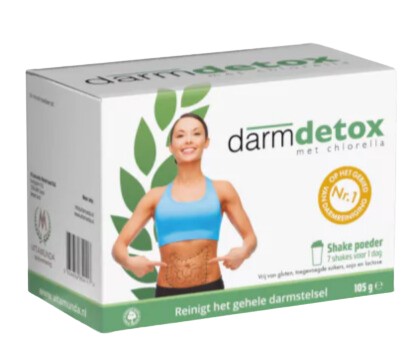
Powder, Bundle | Netherlands
Powder, Bundle | Netherlands